
“The Firehose”

“In order to set up this analogy, I want to remind you that my husband is a full-time firefighter. So, this analogy is based upon real-life, lifesaving skills. When a fire engine is called to the scene of a fire, very soon after arrival, they will scope out the fire from the outside and have a general idea of where they are going. Then, a crew of firefighters (teams of at least two) will enter a doorway with a firehose from which to flow water onto any fires they come upon (“putting the wet stuff on the red stuff”).
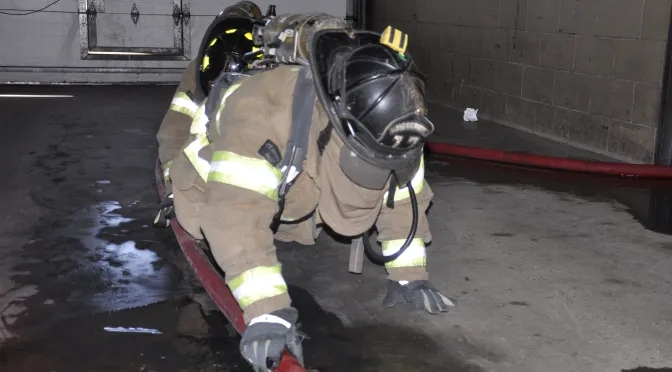
They will pull their hose toward the general vicinity of the fire, feeling for the heat, listening for any sounds of fire and peering into the darkness for any visible “red stuff.” The heat is so hot that a crawl is the only way to keep from being scorched. In most structural fires, visibility is limited because the smoke becomes so thick and black that the firefighters literally cannot see in front of them.
Other firefighters on the outside will help them navigate this darkness by trying to clear the smoke by ventilating (like cutting a hole in the roof). Unfortunately, because of the darkness and overwhelming noise and chaos inside the building, they can become easily turned around. Should a firefighter lose his grip on that hose (his lifeline) he can become lost inside the building and get disoriented trying to find his way back to the hose or his partner. That could be his demise.
If a firefighter is part of a crew and in the building to fight the fire, he naturally wants the nozzle end so he can fulfill his objective. However, if he is lost or disoriented, his mission now becomes his own survival, so he wants—he needs—the pump end. The pump is outside the building where it is safe. The rule is, if a firefighter loses his partner and cannot find him within 30 seconds, then he will call a “mayday” over the radio and then make his primary mission to find his way back to the safety of the awaiting crews outside.
The one constant is that if a firehose was brought into the building, it is his lifeline. It isn’t for the life-giving water it contains but because it enters the house at some point of entry, so it is a guaranteed exit point, as well. So, logic dictates that if he can, in the pitch black, follow the hose back to its entry point, he will be able to be rescued or will be able to crawl out and save himself. While he desperately crawls around searching for the hose, if he’s lucky he’ll find it and be able to follow it back to safety! “Yay! He is saved!”
Nope! He isn’t saved! Why? Because the hose has a nozzle end, which leads deeper into the heat and danger zone, and a supply end, which leads to his fire engine outside (the pump), where he will actually be safe. How is he going to figure out which direction to head? With a limited amount of air in his tank, following the firehose the wrong way might cost him his life. His life depends on him following the hose to safety, not deeper into the fire hazard.

“Smooth-Bump-Bump To The Pump”
A firefighter has been trained to follow the hose, sometimes several feet one way and then several feet back in the other direction looking for a very important clue. What is he looking for? He is looking for the coupling where two sections of hose are connected (much like two sections of garden hose are connected). He has been trained to identify by touch alone in pure darkness which direction goes to the nozzle (danger) and which direction goes to the pump (ultimately to safety). The way the coupling is designed is that the smooth side of the coupling goes toward the nozzle while the bumpy side goes toward the pump.
Once he has determined in pure darkness which side of the coupling will lead him outdoors to safety, he will crawl, following that hose all the way out. The problem is that the hose has now been dragged through multiple rooms, and debris may have fallen onto it, and just finding the fabric of the hose does not guarantee that a firefighter knows which direction to head.
Let’s say, a beam or floor has fallen on part of the hose and it’s hard to determine in the dark which direction to continue; it may be necessary to maneuver a short time to try to feel for another coupling further along. But the coupling will always point to the direction one needs to head for the best chance of survival. The hose may not always be a path that is free of the most debris and impasses, nor is it necessarily the fastest way out, but it is the surest way out.
A firefighter is required to do routine drills in full firefighting gear and breathing apparatus but blindfolded to practice safely rescuing himself because an inexperienced firefighter (or even a disoriented veteran) might forget his training if it weren’t for practice. In the drill, the building is set up, much like a haunted house might be, with loud noises, falling debris, theater smoke, and the hose might be looped around things, changing directions, etc. All the while, instructors are stationed around the building observing them. Everything is done to purposely disorient a firefighter so that they can practice how to rescue themselves in an emergency.
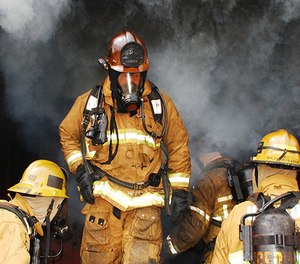
Not long ago, my husband, a 27-year veteran of the department was performing this six-month drill. He came upon the hose and found the coupling but in a moment of disorientation, he instinctually reasoned which direction he felt would direct him toward the pump (away from the danger). Unfortunately, he forgot to use the mnemonic device, “smooth-bump-bump to the pump.” Instead of purposely saying that truth to himself, he relied on what he was perceiving from the environment around him.
From up above came a voice, “Are you sure you want to do that, Bill? Remember your saying!” My husband, realizing that he had forgotten his training because of his disorientation, immediately knew what he had forgotten— “smooth-bump-bump to the pump.” He returned to the coupling, remembered his training and headed out the opposite way where he emerged to find the pump.
Let’s Apply This To Depression
Depression is a lot like being in a hot fire—dark, smoky, lost, disoriented, afraid, feeling defeated, etc. Without a game plan and without ongoing training for your mind, it’s easy to lose yourself in it and become so turned around and lost in the void that ending it all is entertained as an option—just to make it all stop. But, if a person has been trained beforehand, they will have prepared their mind for such a situation.
In a real fire situation, it is imperative to trust your training, not your instincts. Your training says, stay in your protective gear. Stay low to the ground. Feel for your lifeline—the hose. Follow it to a coupling to figure out which end of the hose you’re at, that is which direction leads out of the fire. Then slowly follow that hose back out the way you entered.
Also, remember that firefighters wear breathing apparatus which gives them oxygen. Taking their air off because they’re desperately trying to gasp for a full breath of air will kill them. A fresh breath (full relief) will only be theirs once they get outside. Until then, they need oxygen from a mask forcing air into their lungs. For now, the air from their mask is their only hope. They must settle for this “assistance air” to oxygenate their body, rather than fight to breathe in their own air. It is the difference between life and death.
In depression, there are “spiritual couplings” laid out along the way—promises of God that will give you some direction when you are the most lost. Learning how you can make the simplest of adjustments can, 1) keep you from going further in the wrong direction and, 2) help you to turn around and go in the right direction. But learning this can’t happen in the darkness of the hot fire. Training must begin days, weeks, months, even years in advance. Purposeful training must be your most important task when you are “in the light” and free. It must happen when your mind is clear, and you are able to teach yourself to believe something instinctually so that you won’t resort to panic.
You must learn to trust your Foundational Truths (things we have come to believe about God). You must cling to them as if they are oxygen for your lungs, water for your dehydrated soul or food for your starving body. They are life itself; you must own them. Diabetics don’t go anywhere without their insulin and some emergency sugar. Asthmatics don’t go anywhere without their inhalers. Allergic individuals don’t go anywhere without their epi-pens. You must choose to arm yourself with life-saving beliefs, too.
You must not wait until you get into danger to go looking for your them; you need to have them with you at all times. For when you go down (like our disoriented firefighter), that is, when the darkness creeps in on you, and you are left helplessly ill and unable to escape its hands of terror, there won’t be time to go looking for them then, or try to remember where you last left them. They must be already on you, more importantly, a part of you, not simply something you go looking for as an emergency fix.
Depression is absolutely disorienting. Panic and fret make it worse. The only way to survive depression is to train yourself (not during a “real fire”, but “in the light”) how to think when you are faced with the darkness. First, we must train ourselves to accept assistance from the life supporting truths of God’s grace and mercy—the Breath of Life. We will be tempted to throw off assistance and lean on our own strength. But we must train ourselves to accept our situation, stay calm and not panic.

Panic will cause you to start trying every other method that seems to present itself as an escape; most every method will only leave you trying to circumvent the situation (the depression) which will lead you further into the darkness, to defeat and to despair. You’ve got to travel through it to get out, even though it seems counterintuitive.
Then, we must remember our Foundational Truths which remind us of God’s kindness, patience, acceptance, etc., that is, we must cling to the firehose which is our lifeline. These truths keep us alive during a bout with depression as we wait to be rescued by the Lord.
Using the “Firehose” in Depression
In this analogy, the most important thing to remember in the darkness is our “spiritual couplings”—our “Smooth-bump-bump to the pump”—are our Foundational Truths which are about God.
“Until we find Him in this messy, dark place, we can become so lost that we head so far into the “fire” that we die alone. We must remember what we have practiced believing to be true at the deepest part of our being—without needing emotion to confirm or deny them.“
In depression, emotions are unreliable and will lie to you. Depression will twist the facts and will distort the truth. During a bout of depression is no time to figure out what’s truth and what’s not. Staying with the analogy, the “firehose” can be both positive thoughts or negative thoughts as one direction leads you further into the darkness and the other direction leads you closer to the exit.
The wrong end of the hose will make you forget God’s “already dones;” the fire of God’s anger and displeasure threatens to burn you alive. It’s ruminating on His wrath, for instance, because of the impossible standard of His holiness and righteousness. Its defeat is suffocating when you feel that you’ll never be able to please Him. It’s dwelling on your feelings of unacceptability or your belief that there is no one who could ever love you just as you are that will lead you closer to the “fire” and deeper into the darkness.
The freedom side of the hose, though, is the pump. That is where you will feel relief that Jesus Christ completed everything that God required of you in terms of righteousness. That is where you will feel relief that His mercy and grace are always available to help you in your times of trouble. That is where you will feel relief that His incredible love, tender kindness and compassion are able to breathe life into your weary soul.

So, in depression, it is essential, based on training, to determine which direction you will try to head. The healthiest pathway might not be the easiest, but it can always be used as an adjustment point to turn you back around (like the instructor told my husband, “remember your training!”). It also might not be the fastest way out of your depression, but it is the surest way to get to the exit unscathed. Fast isn’t as important as safe.
And finally, it may or may not get you out of the darkness completely, but it can keep you from spiraling deeper and deeper into the danger zone. The point is, that once you find the “hose,” you are faced with what you are going to believe in your depression. Are you going to believe what your perceptions in depression are telling you? They are distorted—you are disoriented! Or are you going to trust your training? With every Foundational Truth you are able to trust, especially in the dark, you will be able to crawl one step away from the most dangerous areas your depression can lead you and one step closer to a safe place.
As you emerge from each depressive event, if you have depended less on your perceptions (your natural instincts) and depended more on your Foundational Truths, the healthier your exit will be. What I mean is, when you emerge, there will be less residual, consuming self-hate and self-defeat.
As a side note: another thing worth mentioning is that a firefighter is trained that after exhaustive attempts to self-rescue, so lost that he spends all his energy and air looking for the hose, the safest practice is to “shelter in place.” This means he has either been told this over the radio, if his is still available to him, or he makes his own conscious decision to find what he has been trained will be a safe place within the building to wait for rescue.

Within depression, there are times when you, because of the intensity of a depressive episode, feel that there is no relief or improvement possible. During these times, you need to know that you may need to hunker down in a safe place and just endure it waiting for the worst to pass. It’s okay to NOT struggle to get free. Sometimes, the best thing to do is to find your safe place and simply cope the best you can with the difficult situation in which you find yourself. What you need to remember and know is that it isn’t wrong or sinful to be depressed. Depression is an illness. You must learn to give yourself grace and permit yourself to experience your sickness because, quite literally, you have no other choice.
This chapter doesn’t promise you rescue, only the potential for walking yourself back out of your depression’s negative self-talk by reminding yourself of relief-giving biblical truths about God that don’t require that you change or behave better to feel more loved and accepted by Him. Unfortunately, there may be times that you don’t get all the way out to relief before another depressive event overtakes you.
Once again, you’ll feel lost, disoriented and like you’ve lost ground again. The wonderful thing about the Holy Spirit is that He is not only our comforter and our counselor, but He is our teacher and our guide. When this happens, the Spirit of God comes alongside us right where we are and whispers into our ears, “Don’t panic! It’s okay. I see you’re lost again, but let’s figure this out together. Look how much further you escaped from your most dangerous voices of distortion and lies. You are in a better position now than if you hadn’t had any direction. Don’t stand up and start running around looking for escape. Remember your training.”

Then, He encourages us to take baby steps in the right direction again. “Let’s find the hose again; let’s look for the coupling. Let’s figure out which end of this hose leads to peace and freedom and which direction is going to lead us deeper into the darkness, into the heat and into the uncomfortable misery. Now, use these Foundational Truths to back yourself out of here again. You need to back yourself out past your self-hate, self-condemnation and self-accusation.”
What you will discover is that God has given you these truths as tools to give you relief, courage and hope. He’s given you “Beloved!” Believe it! He’s given you “Accepted”, “Friend of God” and “Peace with God!” Trust Him. He’s given you “Mercy and Grace!” Embrace these! Trust your training which you have practiced “in the light” when everything “in the dark” tells you that you aren’t any of those things. Ultimately, the way you use your Foundational Truths is to mentally remind yourself over and over again that what you learn “in the light” can be trusted!

So, when you find yourself “in the dark” over and over again, you have the tools to use if and when you are able to grasp them to back your way out of the worst of depression’s oppressive voices. Like Chonda Pierce says on her video, A Piece of My Mind, “You walk in what you know, not in what you feel!”
It takes incredible faith and perseverance to believe something is true when everything around you is telling you it isn’t. These beliefs must be so rock solid that emotions cannot shake them. Just like your heart will continue to pump without any effort by you, just like that tree in your yard will continue to stand like it has the last 30 years, just like the tides will continue to come in and go out and just like the sun is always in the sky even when the clouds hide it, your Foundational Truths once proven and owned, will become part of who you are! A new identity will become firmly rooted in God’s continual provision for your heart’s greatest torments.
My hope for you is that you will establish a root system so strong and so deep that when the storm winds begin to blow (depression rears its ugly head), you’ll be able to dig down deep and remember these truths. I didn’t say feel them; you won’t feel them when you’re depressed. If you wait for the feelings to believe them, you’re already lost. You will have to firmly believe something is true even when all your senses are telling you something different. You must! It will, in time, give you a way to live that “better broken” in your depression even if you are never completely healed.”
This has been an excerpt from the Book, Discovering God’s Grace in Depression, Chapter 29.
Austel, Heidi. Discovering God’s Grace in Depression: A Personal Story of God’s Intimate Love and Sufficiency in My Brokenness Letsua Publications LLC. Kindle Edition.
“Until we find Him in this messy, dark place, we can become so lost that we head so far into the “fire” that we die alone. We must remember what we have practiced believing to be true at the deepest part of our being—without needing emotion to confirm or deny them.”
Tweet
 Discovering God's Grace in Depression
What an excellent analogy full of very biblical and helpful principles that apply not only to depression but also to other areas of suffering and pain.
LikeLike